
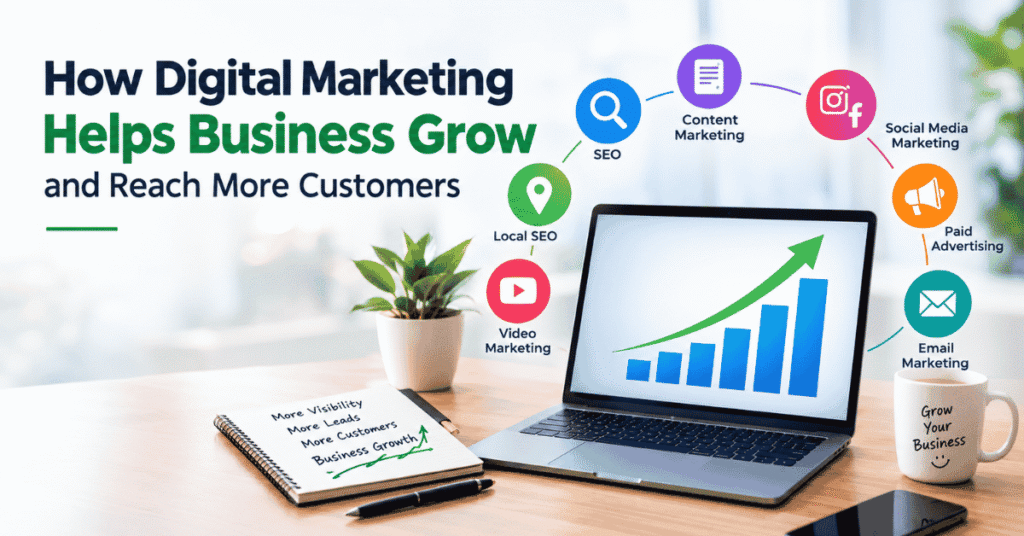
The way people discover, research, compare, and purchase products or services has changed significantly. Today, customers often turn to search engines, social media platforms, websites, online reviews, and other digital channels before making a buying decision. Because of this shift in customer behavior, having a strong online presence has become an important part of modern business growth.
So, how does digital marketing help businesses grow? Digital marketing allows businesses to promote their products or services through online channels, connect with specific audiences, generate leads, build brand awareness, and measure marketing performance. Unlike traditional marketing, businesses can use digital platforms to communicate with potential customers based on their interests, location, search behavior, and other relevant factors.
Whether you operate a small local business, startup, e-commerce company, professional service, or established brand, digital marketing can provide multiple opportunities to reach potential customers online.
However, digital marketing is not simply about posting on social media or running advertisements. It involves using different strategies together to attract the right audience, provide useful information, build trust, and encourage customers to take meaningful actions.
In this guide, we will explore how digital marketing helps businesses grow and reach more customers, the major strategies businesses can use, common mistakes to avoid, and how to create a practical digital marketing strategy for sustainable growth.
What Is Digital Marketing?
Digital marketing refers to the promotion of a business, product, service, or brand through digital channels and online technologies. These channels can include search engines, websites, social media platforms, email, online advertising, video platforms, and other digital communication channels.
For example, when someone searches Google for a product, discovers a business through Instagram, watches a YouTube video before purchasing a service, or receives a promotional email from a company, they are interacting with digital marketing.
Some of the major areas of digital marketing include:
Search Engine Optimization (SEO)
SEO focuses on improving a website’s visibility in search engine results. By creating useful content, optimizing website pages, improving technical performance, and targeting relevant search terms, businesses can attract people who are actively searching for information, products, or services.
Social Media Marketing
Social media marketing involves using platforms such as Instagram, Facebook, LinkedIn, YouTube, and other social networks to build awareness, share content, engage with audiences, and promote products or services.
Content Marketing
Content marketing involves creating useful and relevant content that answers customer questions and provides value. Blog articles, videos, guides, infographics, case studies, and social media content can all form part of a content marketing strategy.
Search Engine Marketing and Paid Advertising
Paid advertising allows businesses to promote their products or services through platforms such as search engines and social media networks. Businesses can create campaigns designed to generate website visits, leads, sales, app installations, or other conversions.
Email Marketing
Email marketing helps businesses communicate directly with existing customers and potential customers. Businesses can use email to share educational content, offers, product updates, newsletters, and personalized messages.
Local SEO
Local SEO helps businesses improve their visibility when people search for products or services in a particular geographic area. This can be especially useful for restaurants, clinics, agencies, retailers, professionals, and other location-based businesses.
Influencer Marketing
Influencer marketing involves collaborating with creators or industry personalities who have an established audience. Depending on the business and campaign, influencers can help introduce products or services to relevant audiences.
These channels can work individually, but businesses often achieve stronger results when they are combined into a coordinated digital marketing strategy.
How Digital Marketing Helps Business Grow
Digital marketing can support business growth in several ways. From increasing visibility to generating leads and understanding customer behavior, online marketing provides businesses with tools to attract and engage potential customers throughout the buying journey.
Let’s look at the major ways digital marketing can contribute to business growth.
1. Increases Online Visibility
One of the biggest advantages of digital marketing is that it can help businesses become more visible to people who are searching for relevant products, services, or information online.
Imagine that someone needs a service and searches for it on Google. If your website appears in relevant search results, that person has an opportunity to discover your business. Similarly, valuable social media content can introduce your brand to people who may not have known about it previously.
SEO, content marketing, social media marketing, video marketing, and paid advertising can all contribute to increasing online visibility.
A strong online presence can help businesses appear across multiple customer touchpoints instead of depending on a single marketing channel.
For example, a potential customer might:
- Discover a brand through Instagram.
- Visit its website.
- Search for the brand on Google.
- Read blog content or customer reviews.
- Compare the offering with competitors.
- Contact the business or make a purchase.
This shows why online visibility is more than simply having a website. Businesses need to create useful digital experiences that help customers find and understand their offerings.
2. Helps Reach the Right Target Audience
Traditional marketing methods can sometimes make it difficult to determine exactly who is seeing an advertisement. Digital marketing provides businesses with more opportunities to define and reach specific audience groups.
Depending on the platform and campaign, businesses can target audiences using factors such as:
- Location
- Age group
- Interests
- Search intent
- Online behavior
- Professional characteristics
- Previous interactions with a business
For example, a local restaurant may want to reach people within a specific geographic area, while a B2B software company may focus on professionals and decision-makers in particular industries.
This level of audience targeting can make marketing campaigns more relevant.
The goal is not simply to reach the largest possible number of people. Instead, businesses should focus on reaching people who are more likely to have a genuine interest in their products or services.
Understanding the target audience also helps businesses create better content. When a company understands its customers’ questions, problems, interests, and buying behavior, it can create marketing messages that are more useful and relevant.
3. Generates More Leads and Customers
Business growth ultimately depends on attracting potential customers and converting them into paying customers. Digital marketing can support this process by creating multiple opportunities for people to discover and contact a business.
A website can include contact forms, inquiry buttons, WhatsApp links, booking systems, product pages, or other conversion opportunities.
Similarly, social media content can direct interested users toward a website, landing page, product page, or contact channel.
Paid advertising can also be used to drive targeted traffic toward specific offers or landing pages.
For example, a digital marketing agency might publish an educational article about SEO. A business owner searching for information about SEO may discover the article through Google. After reading the content, the business owner may visit the agency’s service page and submit an inquiry.
In this situation, content and SEO have helped move a potential customer from search → information → interest → inquiry.
The exact customer journey differs from business to business, but digital marketing gives companies multiple ways to create and manage these customer touchpoints.
4. Builds Brand Awareness and Recognition
Customers are more likely to consider a business when they recognize and understand the brand.
Digital marketing gives businesses many opportunities to consistently communicate their identity, expertise, products, services, and values.
For example, a business can use:
- Social media posts to share educational information
- Blog articles to demonstrate expertise
- Videos to explain products or services
- Email newsletters to maintain customer relationships
- Paid advertising to increase brand exposure
- SEO content to attract people searching for relevant topics
Consistent communication can help customers become familiar with a brand over time.
Brand awareness is particularly important when customers have multiple options. A business that regularly provides useful and relevant information can create more opportunities for potential customers to remember the brand when they are ready to make a purchase.
However, effective brand awareness is not simply about repeatedly promoting a product. Businesses should also provide useful information, answer customer questions, demonstrate expertise, and communicate consistently.
5. Builds Customer Trust and Credibility
Trust plays an important role in purchasing decisions. Before contacting or buying from a business, customers may look at its website, reviews, social media profiles, content, testimonials, and other online information.
Digital marketing provides businesses with several ways to establish credibility.
A professional website can explain what the business offers and how it helps customers. Educational content can demonstrate knowledge and expertise. Customer reviews and testimonials can provide social proof. Regular social media activity can show that the business is active and engaged with its audience.
For example, a customer searching for a digital marketing professional may compare several websites before making contact. A website containing useful articles, clear information about expertise, client-focused solutions, testimonials, and professional contact details may provide more information for the customer to evaluate the business.
This is why digital marketing should not focus exclusively on immediate sales. Building trust throughout the customer journey can also be an important part of long-term business growth.
6. Increases Website Traffic
A website is often one of the most important digital assets for a business. It provides a central location where customers can learn about the company, explore its products or services, read content, and take action.
Digital marketing can help bring relevant visitors to a website through different channels.
Organic Search Traffic
SEO can help web pages appear for relevant searches. When users discover these pages through search engines, they can visit the website organically.
Social Media Traffic
Businesses can share website content through social media platforms and encourage interested users to visit specific pages.
Paid Traffic
Paid advertising can send targeted visitors to landing pages, product pages, service pages, or other relevant website destinations.
Content Marketing Traffic
Useful blog posts, guides, videos, and other content can attract people who are researching topics related to the business.
Increasing traffic alone does not guarantee business growth. The quality and relevance of the traffic matter. Businesses should aim to attract visitors who have a genuine interest in what they offer and provide them with a clear path toward the next step.
7. Helps Businesses Connect With Customers
Digital marketing has changed the way businesses communicate with their audiences. Instead of relying only on one-way advertising, businesses can interact directly with customers through digital platforms.
Social media comments, direct messages, email, online reviews, website forms, and other communication channels allow customers to ask questions and provide feedback.
This interaction can provide valuable insights into customer needs.
For example, if multiple customers ask the same question on social media, a business could create a blog article or video answering that question. If customers frequently mention a particular problem, the business could develop content or services that address it.
In this way, digital marketing can become more than a promotional activity. It can also become a source of customer feedback and market insight.
8. Provides Measurable Results
Another important benefit of digital marketing is the ability to track many aspects of marketing performance.
Depending on the channel and objective, businesses can monitor metrics such as:
- Website traffic
- Search visibility
- Leads generated
- Conversion rate
- Social media engagement
- Ad clicks
- Cost per lead
- Customer acquisition cost
- Return on investment
These measurements can help businesses understand which activities are producing useful results and which areas may need improvement.
For example, if a business is receiving significant website traffic but very few inquiries, the problem may not be traffic generation. The business may need to examine its landing pages, messaging, offers, user experience, or conversion process.
This data-driven approach allows businesses to make marketing decisions based on observed performance rather than relying entirely on assumptions.
9. Supports Local Business Growth
Digital marketing is not only useful for businesses that operate nationally or globally. It can also be highly relevant to businesses serving customers in a specific location.
Local SEO helps businesses improve their visibility for location-based searches.
For example, people may search for terms such as:
- Digital marketer in Andheri, Mumbai
- Best restaurant near me
- Dentist in Mumbai
- Gym in Andheri
- Salon near me
Businesses can improve their local online presence through strategies such as optimizing their Google Business Profile, creating location-relevant website content, maintaining consistent business information, collecting genuine customer reviews, and building relevant local visibility.
For local businesses, appearing when nearby customers are actively searching for a product or service can create valuable opportunities for inquiries and visits.
10. Helps Businesses Compete in the Digital Market
Digital platforms have created opportunities for businesses of different sizes to establish an online presence and communicate directly with their target audiences.
A small business can create educational content, optimize its website for relevant searches, build a social media presence, collect customer reviews, and use targeted advertising without relying entirely on large-scale traditional advertising.
This does not mean every business will achieve the same results or that digital marketing removes competition. Instead, it gives businesses additional channels through which they can communicate their value and reach potential customers.
A focused strategy can help a business identify its audience, understand customer needs, create relevant content, and improve its online visibility over time.
Key Digital Marketing Strategies for Business Growth
Understanding how digital marketing helps businesses grow becomes easier when we look at the specific strategies businesses can use. There is no single digital marketing channel that works equally well for every business. The right approach depends on the target audience, industry, business goals, budget, and customer journey.
Here are some of the key digital marketing strategies that can support business growth.
Search Engine Optimization (SEO)
SEO is the process of improving a website and its content so that relevant pages can appear more prominently in organic search results.
When people search for information, products, or services related to a business, appearing in relevant search results can help bring potential customers to the website.
An effective SEO strategy can include:
- Keyword research
- Creating useful and original content
- On-page optimization
- Technical SEO
- Internal linking
- Website performance optimization
- Local SEO
- Building relevant online authority
For example, a business selling fitness equipment could create useful content around topics such as choosing home workout equipment, benefits of different types of equipment, and workout-related questions. These pages can potentially attract people who are already interested in the products or topics associated with the business.
SEO is generally a long-term strategy. Businesses need to consistently create useful content, maintain their websites, monitor performance, and adapt to changes in search behavior.
Content Marketing
Content marketing focuses on creating and distributing valuable content for a specific audience.
Instead of communicating only promotional messages, businesses can use content to educate their audience, answer questions, solve problems, and demonstrate expertise.
Common forms of content include:
- Blog articles
- Guides
- Videos
- Case studies
- Infographics
- Social media posts
- E-books
- Webinars
- Newsletters
For example, a financial services company could create educational content explaining basic financial concepts. A digital marketing professional could publish articles about SEO, social media marketing, or online advertising.
Useful content can help attract potential customers during the research stage of the buying journey.
Social Media Marketing
Social media platforms allow businesses to communicate with audiences, distribute content, showcase products, answer questions, and build communities.
A social media strategy can include platforms such as Instagram, Facebook, LinkedIn, YouTube, and other relevant networks.
Businesses can use social media to:
- Increase brand awareness
- Share educational content
- Showcase products and services
- Engage with customers
- Promote offers
- Collect feedback
- Drive website traffic
- Generate leads
However, businesses do not necessarily need to be active on every social media platform. It is usually more practical to identify where the target audience spends time and create content suited to those platforms.
For example, a B2B company may focus more heavily on LinkedIn, while a visually driven consumer brand may prioritize Instagram or YouTube.
Performance Marketing
Performance marketing uses measurable digital campaigns where businesses can track actions such as clicks, leads, conversions, purchases, or other defined outcomes.
Paid search and social media advertising are commonly used as part of performance marketing campaigns.
Businesses can create campaigns around specific objectives, such as:
- Generating leads
- Increasing online sales
- Promoting a product
- Driving website traffic
- Increasing registrations
- Getting phone calls
- Promoting an event
One advantage of performance marketing is that businesses can monitor campaign data and make adjustments based on results.
For example, if one advertisement generates more qualified leads than another, the business can analyze the difference and optimize its campaigns accordingly.
Local SEO
Local SEO is particularly important for businesses that serve customers within a specific geographic area.
A strong local SEO strategy can include:
- Optimizing the Google Business Profile
- Creating location-specific website content
- Maintaining accurate business information
- Encouraging genuine customer reviews
- Building relevant local citations
- Creating useful local content
Suppose someone searches for a service in their city or neighborhood. A business with a well-optimized local presence has an opportunity to appear in relevant local search results.
For businesses such as restaurants, clinics, salons, educational institutes, agencies, retailers, and local professionals, local SEO can become an important part of customer acquisition.
Email Marketing
Email marketing allows businesses to communicate directly with people who have subscribed or otherwise provided permission to receive communications.
Businesses can use email to:
- Share newsletters
- Introduce products
- Send educational content
- Announce offers
- Follow up with leads
- Provide updates
- Maintain customer relationships
Unlike social media, where businesses depend on platform algorithms to distribute content, email provides a direct communication channel with an opted-in audience.
Effective email marketing should focus on relevance and value rather than sending excessive promotional messages.
Video Marketing
Video has become an important format for educating, engaging, and communicating with online audiences.
Businesses can use videos to demonstrate products, explain services, answer frequently asked questions, share customer stories, provide tutorials, or introduce team members.
Video content can be distributed through websites, YouTube, Instagram, Facebook, LinkedIn, and other platforms.
For example, an electronics company could create a product demonstration video. A digital marketing professional could create a short educational video explaining how SEO works. A restaurant could showcase its menu or behind-the-scenes preparation process.
The format and length of the video should depend on the platform and audience.
Conversion Rate Optimization
Driving visitors to a website is only one part of digital marketing. Businesses also need to make it easy for visitors to take the desired next step.
Conversion Rate Optimization, commonly known as CRO, focuses on improving the percentage of website visitors who complete a desired action.
Possible conversions include:
- Filling out a contact form
- Making a purchase
- Booking an appointment
- Calling a business
- Signing up for a newsletter
- Downloading a resource
CRO can involve improving website navigation, page design, headlines, calls to action, forms, content, page speed, and overall user experience.
A business may discover that increasing conversions from existing traffic can be more useful than simply trying to generate additional traffic
How Different Types of Businesses Can Use Digital Marketing
Digital marketing can be adapted to different business models. The strategy should reflect the company’s customers, products, services, location, and business objectives.
Small Businesses
Small businesses can use digital marketing to establish their online presence and compete for attention within their target market.
A small business may begin with:
- A professional website
- Google Business Profile optimization
- Local SEO
- Social media presence
- Educational content
- Customer reviews
- Targeted advertising
For example, a local bakery could use Instagram to showcase products, Google Business Profile to help nearby customers discover the business, and a website to provide menus, contact information, and ordering options.
The focus should be on choosing practical channels rather than trying to use every available digital platform.
Local Businesses
Local businesses depend heavily on customers within a specific geographic area.
Digital marketing can help them connect with people who are actively looking for nearby products and services.
A local business can focus on:
- Local SEO
- Google Business Profile
- Location-based content
- Online reviews
- Social media
- Local advertising
- Mobile-friendly website experiences
For example, someone looking for a service in Andheri, Mumbai may use Google to search for businesses nearby. A business that has accurate online information, useful website content, strong local visibility, and genuine customer reviews can provide more information for that potential customer to consider.
Startups
Startups often need to create awareness while working with limited resources. Digital marketing can provide several channels for reaching potential customers and testing marketing messages.
Startups can use:
- Content marketing
- SEO
- Social media
- Email marketing
- Paid advertising
- Video marketing
- Landing pages
A startup can test different messages, audiences, content formats, and campaigns to understand what resonates with its target market.
Because startups may still be developing their market positioning, tracking results and learning from customer behavior can be particularly useful.
E-commerce Businesses
For e-commerce businesses, digital marketing can play a major role throughout the customer journey.
Customers may discover products through social media, search engines, advertisements, videos, influencers, or email campaigns.
E-commerce businesses can use:
- Product-focused SEO
- Shopping campaigns
- Social media marketing
- Retargeting
- Email marketing
- Product videos
- Influencer collaborations
- Content marketing
For example, a customer might discover a product through a social media video, visit the online store, compare products, read reviews, and eventually complete a purchase.
Businesses can analyze each stage of this journey to identify opportunities for improvement.
Personal Brands and Professionals
Digital marketing is also useful for professionals who want to establish authority and communicate their expertise online.
Professionals such as consultants, marketers, coaches, designers, educators, creators, and other specialists can use digital platforms to showcase their knowledge.
A personal brand strategy may include:
- A professional website
- SEO-focused articles
- LinkedIn content
- Social media posts
- Educational videos
- Case studies
- Personal insights
- Email newsletters
For example, a digital marketer can publish educational articles about SEO and performance marketing, share practical tips on LinkedIn and Instagram, and create videos explaining digital marketing concepts.
Over time, consistent educational content can help communicate expertise and create opportunities for professional connections and business inquiries.
Digital Marketing vs Traditional Marketing
Both digital and traditional marketing can be used to promote businesses, but they operate differently.
Traditional marketing commonly includes channels such as television, newspapers, magazines, radio, billboards, brochures, and direct mail.
Digital marketing includes channels such as search engines, websites, social media, email, online advertising, and digital content.
Some important differences include:
| Factor | Digital Marketing | Traditional Marketing |
|---|---|---|
| Reach | Can reach local, national, or global audiences | Depends heavily on the medium and geographic coverage |
| Targeting | Offers detailed audience targeting in many channels | Often uses broader audience targeting |
| Measurement | Many digital activities provide detailed performance data | Measurement can be more difficult for some channels |
| Interaction | Allows direct online interaction | Usually more one-directional |
| Flexibility | Campaigns and content can often be changed quickly | Changes may require more time and resources |
| Content | Can include interactive and multimedia formats | Often relies on fixed formats |
| Cost control | Many platforms allow flexible budget management | Costs vary significantly by medium |
The choice between digital and traditional marketing depends on the business, audience, objectives, and available resources. Some businesses may use a combination of both approaches.
The important consideration is not simply whether a marketing channel is digital or traditional. Businesses should evaluate whether the channel can effectively reach the intended audience and support the desired business objective.
How to Create a Digital Marketing Strategy for Business Growth
A successful digital marketing strategy should begin with clear business objectives rather than simply choosing popular platforms.
1. Define Your Business Goals
Start by identifying what you want your digital marketing activities to achieve.
Possible goals include:
- Increasing brand awareness
- Generating leads
- Increasing sales
- Growing website traffic
- Getting more inquiries
- Improving customer retention
- Increasing local visibility
Clear goals make it easier to choose appropriate marketing channels and performance metrics.
2. Identify Your Target Audience
Understand who your ideal customers are.
Consider their:
- Needs
- Problems
- Interests
- Location
- Buying behavior
- Search behavior
- Preferred communication channels
The more clearly a business understands its audience, the easier it becomes to create relevant marketing content.
3. Research Competitors
Competitor research can provide useful information about the digital landscape.
Look at competitors’:
- Websites
- SEO presence
- Social media content
- Advertising messages
- Customer reviews
- Content strategies
- Offers and positioning
The purpose is not simply to copy competitors. Instead, research can help identify market expectations, content gaps, and opportunities for differentiation.
4. Choose the Right Digital Channels
Not every business needs every digital marketing channel.
Choose channels based on where your target audience is active and where your business can consistently provide value.
For example, a local service business may prioritize local SEO and Google Business Profile, while a B2B company may focus heavily on SEO, LinkedIn, and educational content.
5. Create Valuable Content
Create content that addresses real customer questions and problems.
Instead of producing content only around what the business wants to sell, consider what potential customers are searching for and what information can help them make better decisions.
6. Launch Your Campaigns
Once your strategy and content are ready, begin implementing the selected marketing activities.
This could include publishing SEO content, launching social media campaigns, running paid advertisements, sending email newsletters, or optimizing local search visibility.
7. Track Performance
Use relevant metrics to understand how your campaigns are performing.
Depending on your objectives, you might monitor traffic, leads, conversions, engagement, rankings, advertising costs, or sales.
8. Analyze and Optimize
Digital marketing should not be treated as a one-time activity.
Review performance regularly and identify what is working, what is underperforming, and what can be improved.
Testing different content, audiences, offers, landing pages, and campaigns can help businesses make more informed marketing decisions.
Common Digital Marketing Mistakes Businesses Should Avoid
While digital marketing provides many opportunities, businesses can also waste time and resources without a clear strategy.
Not Defining a Target Audience
Trying to market to everyone can make messaging too broad. Businesses should identify the audiences most relevant to their products or services.
Focusing Only on Selling
Constant promotional content can reduce engagement and make it difficult to build trust. Businesses should balance promotional content with useful and educational information.
Ignoring SEO
Businesses may invest heavily in social media while overlooking search visibility. SEO can help businesses reach people who are actively searching for relevant information, products, or services.
Publishing Inconsistent Content
Inconsistent marketing can make it difficult to build momentum. Businesses should develop a realistic content schedule that they can maintain over time.
Not Tracking Results
Without measuring performance, businesses may not know which marketing activities are contributing to their goals.
Using Every Platform Without a Strategy
Being present on every social platform is not necessarily beneficial. Businesses should prioritize platforms that align with their audience and objectives.
Ignoring Mobile Users
Many people access websites and social media through mobile devices. Businesses should ensure their websites and digital experiences work effectively on smaller screens.
Not Optimizing for Local Searches
Location-based businesses can miss potential customers if their online presence does not clearly communicate where they operate and what services they provide.
How Long Does Digital Marketing Take to Show Results?
One of the most common questions businesses ask before starting digital marketing is: How long does digital marketing take to show results?
There is no fixed timeline that applies to every business. Results depend on factors such as the industry, competition, target audience, website quality, marketing budget, selected channels, existing online presence, content quality, and consistency.
Different digital marketing strategies can also produce results at different speeds.
SEO Results
SEO is generally a long-term strategy. Search engines need time to discover, understand, and evaluate website content. A new website may require consistent optimization and content creation before it begins generating meaningful organic visibility.
Factors such as keyword competition, website authority, technical SEO, content quality, and search intent can influence how quickly individual pages gain visibility.
The focus should therefore be on building sustainable organic visibility rather than expecting immediate results from SEO.
Paid Advertising Results
Paid advertising can generate traffic and interactions much faster because businesses can launch campaigns and reach selected audiences soon after approval.
However, launching an advertisement does not automatically guarantee profitable results. Campaign performance depends on factors such as audience targeting, creative quality, offer, landing page experience, competition, and budget.
Businesses should monitor campaign data and continuously optimize their advertisements.
Social Media Results
Social media growth can also vary significantly. Some content may receive substantial reach quickly, while other content may take time to gain attention.
Consistency, content quality, audience relevance, engagement, and platform-specific strategy can all influence performance.
Content Marketing Results
Content marketing is usually a long-term activity. A single article may attract visitors, but a larger content library can create more opportunities to appear for relevant searches and answer customer questions.
The most important point is that digital marketing should be viewed as an ongoing process rather than a one-time campaign.
Businesses should establish realistic expectations, track meaningful metrics, and continuously improve their strategy based on actual performance.
Frequently Asked Questions About Digital Marketing
How does digital marketing help a business grow?
Digital marketing can help a business grow by increasing online visibility, reaching relevant audiences, generating leads, building brand awareness, attracting website visitors, and creating opportunities for customer engagement. Businesses can use SEO, social media, content marketing, paid advertising, email marketing, and other digital channels based on their specific goals.
Why is digital marketing important for small businesses?
Digital marketing can help small businesses establish an online presence and reach potential customers without depending entirely on traditional advertising. Strategies such as local SEO, social media marketing, content marketing, and targeted advertising can help small businesses connect with relevant audiences and communicate their products or services.
Can digital marketing increase sales?
Digital marketing can contribute to sales by helping businesses attract potential customers, generate leads, build trust, and guide people toward purchasing decisions. However, sales results also depend on factors such as product quality, pricing, customer experience, competition, and the effectiveness of the overall sales process.
Which digital marketing strategy is best for business growth?
There is no single strategy that is best for every business. The right approach depends on the business model, target audience, industry, location, goals, and available resources. SEO may be important for businesses focused on organic search visibility, while paid advertising may be useful for campaigns requiring targeted traffic. Many businesses use multiple strategies together.
How does SEO help businesses attract customers?
SEO helps businesses improve their visibility for relevant search queries. When a website appears for searches related to its products, services, or expertise, it can attract people who are actively researching those topics. Useful content, relevant keywords, technical optimization, and a positive website experience are important components of SEO.
Is digital marketing suitable for local businesses?
Yes. Digital marketing can be particularly useful for local businesses because customers frequently use search engines, maps, social media, and online reviews to find nearby products and services. Local SEO, Google Business Profile optimization, location-specific content, reviews, and targeted advertising can help local businesses improve their online visibility.
How much does digital marketing cost?
The cost of digital marketing varies depending on the business goals, strategies, channels, competition, scope of work, and advertising budget. Organic strategies such as SEO and content marketing require time and resources, while paid advertising requires an advertising budget in addition to campaign management and creative costs.
Businesses should create a budget based on their objectives and evaluate performance rather than choosing a marketing budget based only on what competitors spend.
How can a business measure digital marketing success?
Businesses can measure digital marketing performance using metrics that match their objectives. Common metrics include website traffic, search visibility, leads, conversion rate, engagement, cost per lead, customer acquisition cost, sales, and return on investment.
The most useful metrics depend on the business goal. For example, a brand awareness campaign may focus on reach and engagement, while a lead-generation campaign may focus more heavily on qualified leads and cost per lead.
Why a Consistent Digital Marketing Strategy Matters
Digital marketing works best when individual activities support a broader business objective.
For example, SEO can bring organic visitors to a website, while content marketing can educate those visitors. Social media can distribute the content and build engagement, while email marketing can help maintain relationships with interested customers. Paid advertising can then be used to reach specific audiences or promote selected offers.
This demonstrates how different channels can work together.
A business should therefore avoid treating SEO, social media, content marketing, paid advertising, and email marketing as completely separate activities.
Instead, these channels can form different parts of a broader customer journey.
For example:
Awareness → Discovery → Engagement → Consideration → Conversion → Retention
A potential customer may first discover a business through a social media post. Later, they may search for the brand on Google, visit the website, read an article, compare services, and eventually submit an inquiry.
After becoming a customer, they may continue interacting with the business through email, social media, or other channels.
A coordinated strategy can help businesses create a more consistent experience throughout this journey.
The Role of Data in Digital Marketing Growth
One of the defining characteristics of digital marketing is the amount of data businesses can collect and analyze.
Businesses can use performance information to understand questions such as:
- Which marketing channels generate the most traffic?
- Which pages receive the most visits?
- Which keywords attract potential customers?
- Which advertisements generate leads?
- Which content receives the most engagement?
- Where do website visitors leave the customer journey?
- Which campaigns generate conversions?
This information can support better decision-making.
For example, suppose a business discovers that one type of blog article attracts significantly more relevant visitors than another. The business may decide to create additional content around similar topics.
Similarly, if an advertising campaign receives many clicks but very few conversions, the business may investigate the landing page, offer, audience targeting, or messaging.
The objective of data analysis is not simply to collect numbers. It is to use meaningful information to improve marketing decisions.
Digital Marketing Is an Ongoing Growth Process
Digital marketing should not be considered a one-time activity.
Customer behavior changes. Search trends change. Social media platforms evolve. Competitors introduce new strategies. Businesses launch new products and services. Because of these changes, digital marketing strategies often need regular review and optimization.
A business may begin with SEO and social media, later introduce email marketing, and eventually expand into paid advertising or video marketing based on its results and business requirements.
The key is to build a sustainable process.
Instead of asking only, “How quickly can I get results?”, businesses should also ask:
- Am I reaching the right audience?
- Is my content useful?
- Am I generating qualified leads?
- Is my website converting visitors?
- Are customers trusting my brand?
- Which channels are producing meaningful results?
- What can I improve next?
These questions can help businesses develop a more effective long-term approach.
Conclusion: How Digital Marketing Helps Business Grow
Digital marketing has become an important part of the modern customer journey. People use search engines, websites, social media, videos, reviews, and other digital platforms to discover businesses, research products, compare options, and communicate with brands.
This creates opportunities for businesses of different sizes to build visibility and connect with potential customers.
As we have explored, how digital marketing helps business grow can be understood through several key areas. Digital marketing can increase online visibility, help businesses reach relevant audiences, generate leads, build brand awareness, establish credibility, increase website traffic, improve customer communication, support local businesses, and provide measurable performance data.
However, successful digital marketing is not simply about being present online.
Businesses need to understand their audience, define clear objectives, select appropriate channels, create useful content, track performance, and continuously improve their approach.
SEO can help attract people through organic search. Social media can help businesses communicate and engage with audiences. Content marketing can answer customer questions and demonstrate expertise. Performance marketing can provide targeted promotional opportunities. Local SEO can help location-based businesses become more visible to nearby customers. Email marketing can support ongoing customer relationships.
The most effective strategy will differ from one business to another.
Therefore, businesses should focus less on following every digital marketing trend and more on understanding what their customers need and how different digital channels can support their business objectives.
In a competitive online environment, a strong digital presence can help a business become easier to discover, easier to understand, and easier to engage with.
Ultimately, digital marketing should not be viewed only as a way to generate immediate sales. It can also be used to build visibility, trust, relationships, and long-term brand value.
When businesses combine the right strategy with valuable content, consistent execution, data-driven decisions, and continuous optimization, digital marketing can become an important part of sustainable business growth.
Final Takeaway
If you are a business owner looking to grow online, start by understanding who your customers are, what they are searching for, what problems they want to solve, and where they spend their time online.
Then choose the digital marketing channels that align with those customer behaviors and your business goals.
Growth does not come from simply being active online. It comes from having a clear strategy, delivering value, reaching the right audience, measuring performance, and improving consistently.
That is what makes digital marketing a valuable tool for businesses looking to build a stronger online presence and reach more customers.
Looking for a Digital Marketer to Grow Your Business Online?
Knowing how digital marketing works is important, but putting the right strategies into action requires planning, consistency, and continuous optimization.
If you are a business owner, startup, entrepreneur, or professional looking for help with digital marketing, I can help you build and implement a strategy focused on your specific business objectives.
I offer digital marketing services including SEO, Social Media Marketing, Performance Marketing, Local SEO, Google Business Profile Optimization, Content Marketing, and Lead Generation.
Whether your goal is to increase online visibility, attract more relevant customers, generate leads, or build a stronger digital presence, the right marketing strategy can help you move toward those goals.
Ready to improve your online presence? Get in touch with Digital Shivam Kushwaha to discuss your digital marketing requirements.
Website: kushwahashivam.in
Email: digitalshivamkushwaha@gmail.com
LinkedIn: Shivam Kushwaha